

This Week in AI: Licensing, Job Displacement & Safety Laws (Sep 19, 2025)
Hey folks — another big week in AI. Between regulatory shifts, executive warnings, and tech media moves, 2025 keeps showing how fast things are changing.
Artificial intelligence isn’t slowing down — and neither is the news around it. From corporate shakeups to government oversight, the pace of change in 2025 can feel overwhelming. That’s where this weekly AI roundup comes in: a quick, clear breakdown of the top stories shaping the AI landscape right now.
This week’s AI news brings a mix of regulation, corporate strategy, and media innovation. Meta is negotiating licensing deals to feed its AI products, Anthropic’s CEO has issued a stark warning about job displacement, and California lawmakers just passed a bill that could become a model for global AI regulation. On the media side, USA Today is jumping into generative AI with a chatbot for its readers, while Meta’s research arm pushes ahead on its next big model.
Together, these developments show the tension between innovation and oversight, between optimism for AI’s potential and concern about its risks. Let’s dive into this week’s AI news roundup.
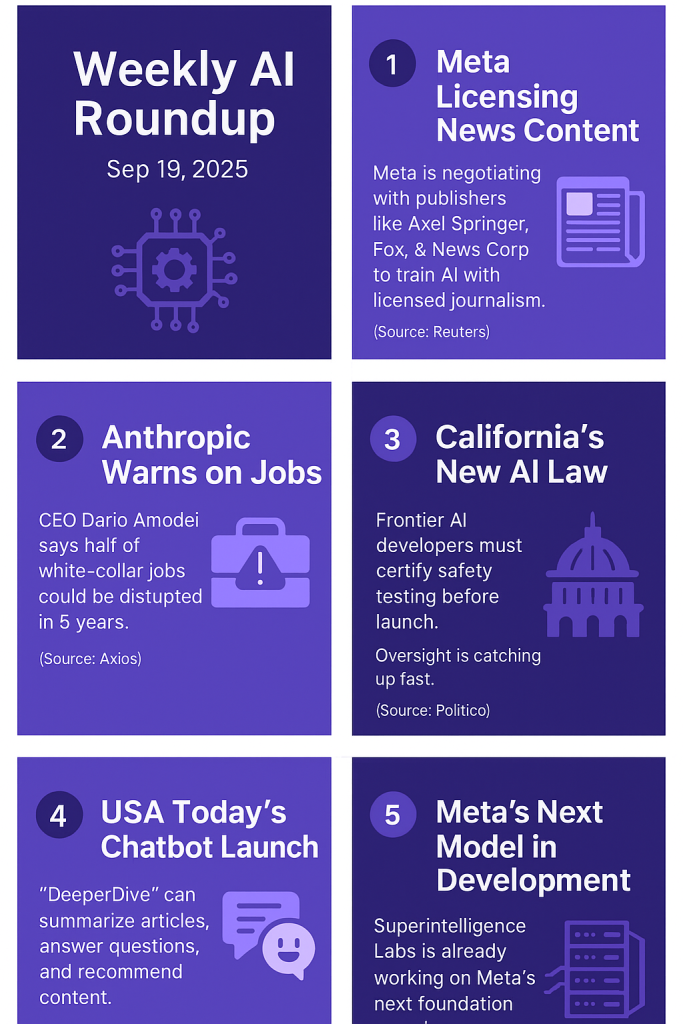
Weekly AI Roundup: Top Stories This Week
- Meta Eyes Licensing Deals with News Outlets
Meta is reportedly in talks with major publishers — including Axel Springer, Fox Corporation, and News Corp — to license news content for use in its AI products. According to Reuters, the company’s goal is to secure high-quality data to train and refine its AI systems, while also avoiding potential legal disputes over copyright.
This move reflects a growing trend: tech giants are recognizing that high-value training data often comes from journalism. For Meta, licensing content could strengthen its AI’s ability to summarize, fact-check, and generate more reliable outputs. It also helps the company sidestep criticism that AI models exploit existing work without properly compensating creators.
Still, there are big questions. How much will publishers be paid? Will smaller outlets be left out of these deals, further consolidating media power in the hands of a few? And will readers trust AI-generated summaries if they replace original reporting?
For businesses and consumers, the implications are clear: AI tools may soon deliver news content that feels authoritative, but the economics of who benefits — publishers, platforms, or users — are still being negotiated. Reuters - Anthropic Warns of Rapid Job Displacement
The future of work has been at the center of AI debates for years, but this week, the conversation took on a sharper edge. Dario Amodei, CEO of Anthropic, warned that artificial intelligence could disrupt up to half of white-collar jobs within the next five years. Speaking at a tech conference, Amodei emphasized that while AI creates new opportunities, the speed of displacement may outpace society’s ability to adapt. (Axios)
This is one of the starkest public warnings yet from a leading AI executive. It reflects growing unease that large language models and generative AI tools aren’t just automating repetitive tasks — they’re beginning to replace knowledge work in areas like research, analysis, customer service, and even creative industries.
The warning echoes concerns from economists who argue that AI may widen inequality if reskilling programs, corporate planning, and policy safeguards fail to keep pace. At the same time, other experts counter that AI will create entirely new job categories — just as past technological revolutions did.
For professionals, the takeaway is twofold: develop AI-resistant skills like strategy, leadership, and creativity, and learn to use AI as a tool, not just view it as competition. Axios - California Passes New AI Safety Bill
California lawmakers have passed one of the most significant AI regulations to date: a bill requiring companies that build “frontier AI models” to disclose and certify their safety testing procedures before deployment. (Politico)
The legislation is designed to address concerns that advanced AI systems — with their ability to generate misinformation, amplify bias, or even cause security risks — are being developed faster than oversight can keep up. Under the bill, companies will need to provide detailed reports on how they test for risks like misuse, disinformation, and system failures.
Supporters argue that this move puts California in a leadership position, much like it did with environmental and data privacy laws. If enforced effectively, it could set a national precedent in the U.S. and potentially influence global regulatory efforts.
Critics, however, warn that the requirements may slow down innovation and create extra compliance burdens for startups that lack the resources of tech giants. The balance between accountability and innovation remains the central challenge.
For businesses, especially those using or building on frontier models, this law signals a future where transparency and compliance are not optional extras but core to doing business. Politico - USA Today’s Generative AI Chatbot Launch
One of America’s largest newspapers is officially stepping into the generative AI era. USA Today, owned by Gannett, has launched DeeperDive — a chatbot that uses AI to summarize articles, answer reader questions, and recommend content across the publisher’s network. (Wired)
The goal is clear: keep readers engaged at a time when attention spans are shrinking and competition for eyeballs is fierce. Instead of scrolling endlessly, readers can ask the chatbot to highlight the most relevant details or suggest related coverage.
For Gannett, which manages more than 200 local news outlets, DeeperDive is also a business move. By integrating AI into news delivery, the company hopes to build a more personalized experience that drives reader retention and subscription value.
But the rollout also raises questions. Will readers trust AI-generated summaries over traditional journalism? How will journalists feel about their work being filtered through a chatbot? And could this deepen concerns about misinformation if the system misinterprets complex reporting?
This experiment reflects a bigger trend: AI-powered personalization in media. As news outlets struggle with declining ad revenue, tools like DeeperDive may become more common — but their long-term impact on journalism remains uncertain. WIRED - Meta’s Next AI Model Is Already in the Works
Even as Meta negotiates content licensing and navigates regulatory debates, its research arm — Superintelligence Labs — is already working on the company’s next-generation AI foundation model. According to Meta CFO Susan Li, the project is still in an experimental phase, but it highlights the constant arms race driving the AI industry. (Times of India)
Meta’s long-term bet is clear: larger, more capable models that can power everything from consumer-facing chatbots to enterprise applications. By investing early, the company positions itself to compete directly with Google’s Gemini and OpenAI’s GPT line.
But rapid development also brings risks. Bigger models require massive amounts of energy and data, raising concerns about sustainability and privacy. And as capabilities scale, the gap between lab innovation and safe deployment only grows wider.
For businesses and professionals, the key insight is that the tools we use today may look outdated in just a year or two. Companies like Meta aren’t slowing down — they’re accelerating. The challenge will be ensuring that practical applications and safeguards keep up with technological breakthroughs. The Times of India
Quick Take
This week’s headlines underline a central theme: AI is no longer experimental — it’s operational.
- Meta’s licensing talks show how much value lies in quality data.
- Anthropic’s stark warning reminds us that job displacement isn’t a distant concern; it’s here now.
- California’s new law proves that regulation is catching up, faster than many expected.
- USA Today’s chatbot experiment shows how traditional industries are adapting to stay relevant.
- Meta’s next foundation model confirms the arms race is only accelerating.
The balance between innovation and oversight is becoming the defining story of AI in 2025. For businesses, professionals, and policymakers, the challenge isn’t whether AI will reshape the landscape — it’s how to adapt as it does.
For More
- For a deeper dive into AI regulation, see our article “AI Regulation Is Coming: What It Means for Businesses“
- Also good: the “AI Hype Cycle” piece understanding where we are vs where we might head.
Stay Ahead in AI
That’s it for this week’s weekly AI roundup. If you want the top stories, evergreen guides, and clear commentary delivered straight to your inbox, subscribe to the GlassOfAI Newsletter.


